



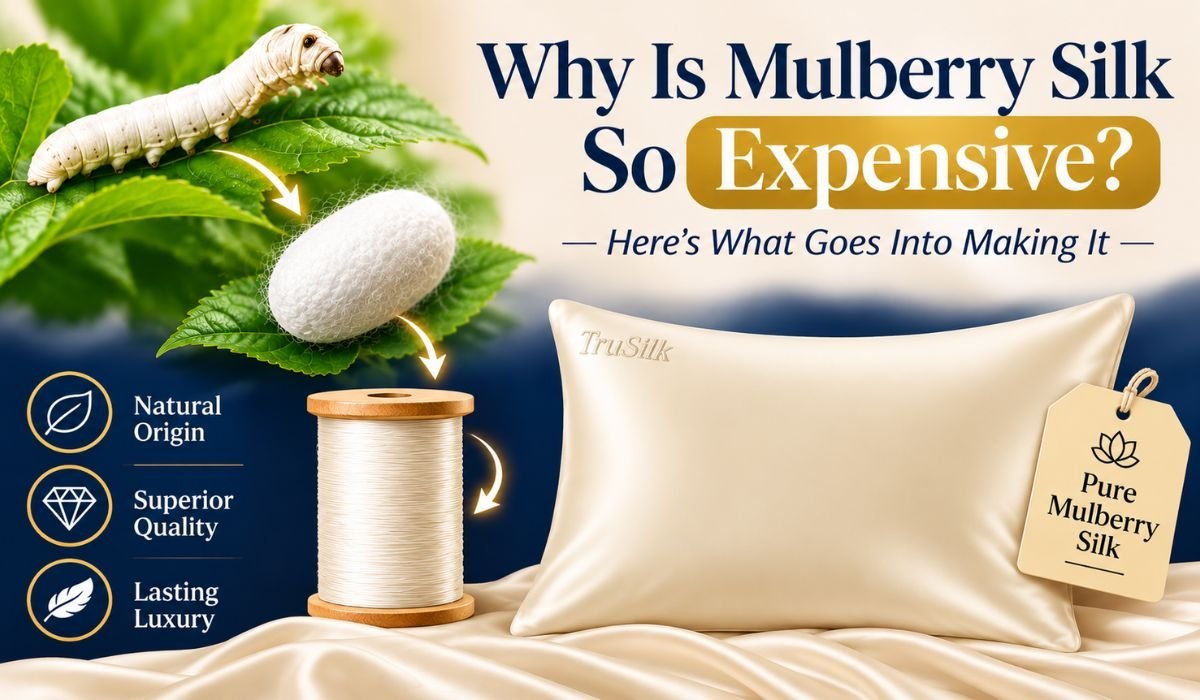
Why Is Mulberry Silk So Expensive? Here’s What Goes Into Making It
Producing 1 kg of silk takes about 104 kg of mulberry leaves and 3,000 silkworms. Know why pure mulberry silk costs more than synthetic satin.


If you search for mulberry silk pillowcases to buy online, there might be hundreds of options available, and many people may always look for the cheapest one on Amazon, Flipkart, or any commercial site. But when you look closely at their product description, there will be no claim of pure mulberry silk. Instead of that, the description might say “silky touch, soft as mulberry silk”; these claims can be misleading and hide the truth that the pillowcase you are buying is not 100% pure mulberry silk but a synthetic satin.
Many people get fooled because of the low price of the product.
There are also some people who are aware of the benefits of using mulberry silk essentials for skin, hair and sleep. Still, they question the pricing of the products as “EXPENSIVE”.
There is a difference between “expensive and costly”, and this depends on the value and demand of the product.
“Cost” here refers to the investment in terms of effort, resources, and human labor required to create the item, which is why its cost is higher than usual. However, when a product is considered 'expensive,' it often means that the demand for it exceeds its actual production cost, a situation sometimes driven by branding. This applies to collectible items, celebrity-endorsed brands, or luxury labels; these products often serve a purpose that could be fulfilled by an
ordinary alternative without any loss in functionality, yet the element of 'status' comes into play.
However, pure mulberry silk has no replacement but a matter of choice and preference. If you really want to purchase an authentic silk essential, you must consider the cost as well.
Important Facts and Stats about Silk Production in India
According to Wikipedia, India is the world's second-largest silk producer after China, contributing approximately 14% of global silk production, compared with China's 54% in the cited figures.
How is a single piece of Mulberry Silk Fabric made?
But what makes silk production particularly interesting is the amount of natural resources it requires. Producing around 1 kg of silk can require approximately 104 kg of mulberry leaves and nearly 3,000 silkworms. A single silkworm
produces a continuous silk thread of around 1.6 kilometres while spinning its cocoon over two to three days.
And that's not where the work ends. Once the cocoons are ready, the silk filaments are carefully extracted through a process called reeling. Since a single filament is extremely fine, around three to ten strands are combined to create a usable thread. This thread then goes through several stages, including dyeing, weaving and finishing, before it becomes the fabric used in everyday products.
Now, imagine the effort involved in producing enough quality silk fabric for something as simple as a pillowcase. The price starts making a little more sense, doesn't it?
Final verdict: Silk vs Synthetic Satin
This is why comparing pure mulberry silk with a synthetic satin pillowcase based only on appearance or price isn't entirely fair. They may look similar, but the materials, production processes and properties are different.
Of course, choosing an affordable alternative is a personal decision, and not everyone needs to spend more on silk. But if you're looking to make a long-term investment in your hair, skin and sleep routine, genuine mulberry silk is worth considering. You're not just paying for a shiny piece of fabric; you're choosing a natural material that takes considerable effort to produce.
If you are truly interested in buying pure mulberry silk essentials for yourself or for someone else, considering a credible brand is recommended. Here are plenty of options; TruSilk is one brand worth exploring. It offers pure mulberry silk pillowcases, scrunchies and eye masks, with 22-momme, Grade 6A silk used in its scrunchies.
What's Your Reaction?
 Like
0
 Dislike
0
 Love
0
 Funny
0
 Wow
0
 Sad
0
 Angry
0

Namrata Agrawal, founder of TruSilk, turned her personal journey with sensitive skin, rosacea, and hair concerns into a purpose—creating 100% mulberry silk pillowcases for gentler skin, hair, and sleep.









Comments (0)