



Where Can You Find the Right Upcut Saw for Sale for Your Shop?

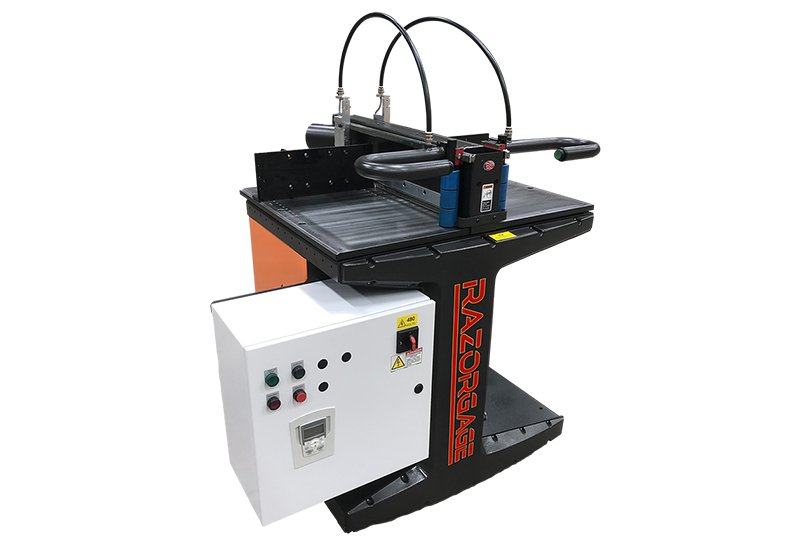


Walk through most cabinet or window shops in the afternoon and you’ll see the same scene. Someone is standing at a saw with a tape measure and a pencil, cutting the same part for the hundredth time. If you’re looking for an upcut saw for sale, you’re probably tired of that routine. A saw that cuts straight is easy to find. A saw that cuts the right length every time, with less waste and less hand-holding, is harder. That’s the gap RazorGage has been working on, and this guide shows how to judge what you’re buying.
What an Upcut Saw Does Well
On an upcut saw, the blade sits below the table. When the cut starts, it rises up through the material while clamps hold the board in place. That setup suits lineal stock like moulding, face frame parts, rails, stiles and even aluminum extrusions. Many shops use it as a cutoff station: feed a long board, cut it to length, move to the next one.
The saw alone is only as accurate as the person setting the stop. A good blade and a strong motor won’t fix a wrong measurement. That’s why the positioning system matters as much as the saw.
The Hidden Cost of Measuring by Hand
Hand measuring feels cheap because nobody sends an invoice for it. But think about the real numbers. A part cut 1/16" short is scrap. A board cut in the wrong order leaves an offcut that can’t be used. An operator who reads the wrong line on a cutlist loses ten minutes, and nobody notices until assembly.
Those small losses pile up quietly across a month. Shops that move to an automatic saw usually find the savings aren’t in speed alone. They show up in fewer remakes, better material yield and operators who can stack parts instead of chasing numbers.
What to Check Before You Buy
Start with accuracy, but ask how it’s measured. Ask what the saw holds on a normal day, not only in a demo. Then look at the clamping. If a machine only half-clamps the leading or trailing edge of a board, parts get scrapped, and it’s also an unsafe condition.
Next, look at the software. Can you import cutlists from your design program, or do you retype everything at the saw? Can you sort jobs by material, colour or customer right at the machine? Finally, check the support behind the product. A saw is a long-term purchase, and the people who built it should pick up the phone when something goes wrong.
How RazorGage Approaches the Problem
RazorGage, based in Ames, Iowa, builds automatic measuring and positioning systems and pairs them with its Cyclone upcut saw. Two systems are worth a closer look.
The APS Automatic Optimizing Upcut Saw System
The APS is built around the RazorGage ST measuring system and a 7.5 hp Cyclone upcut saw. Its main feature is the automatic pusher. The operator pushes “Go” and steps back, so one person can both feed the saw and stack finished parts without stopping. RazorGage says part length accuracy of +/-.005" is possible, depending on the application. The pusher moves up to 200 lb at 10 inches per second, or lighter loads at up to 55 inches per second. You can send cutlists to the saw by Ethernet, USB drive or Wi-Fi, and the system also cuts aluminum with an optional blade and mist lubrication.
The RazorOptimal Optimizing Saw System
The RazorOptimal goes a step further by dealing with defects. The operator marks bad spots on the board with a crayon. The saw scans the material, finds the marks, and fits the remaining parts into the clear sections. It then advances the stock, cuts it, and can print part information right on the piece. It comes with a 500mm blade, with a 600mm blade available. Shops that need pocket holes can choose an 18-inch down-cut version that also drills pocket holes and scribes face frame layout marks. All of it runs from a Windows touchscreen PC that stores thousands of cutlists.
Who Gets the Most Out of These Machines
Cabinet shops, door and window makers, furniture builders, truss and pallet operations and aluminum fabricators all cut lineal stock all day. If your crew cuts many parts to a repeating list, or you work with solid wood where knots and splits decide what’s usable, an optimizing saw pays off fastest.
Smaller shops benefit too, though in a different way. One person can run the saw while others work on assembly. That’s often the point where a shop stops hiring just to keep up with cutting.
Practical Things to Plan For
Before you order, check your power. The Cyclone saw needs either 230 VAC three-phase at 30 amps or 460 VAC three-phase at 20 amps, plus a standard 120 VAC circuit. Dust collection needs two 4-inch ports with at least 600 cfm for light dry material, and the compressed air supply should deliver 80 psi, filtered and dry. None of this is hard, but it’s much easier to sort out before the machine arrives than after.
Final Thoughts
Buying an upcut saw for sale shouldn’t be about the lowest sticker price. It should be about how many good parts you get from every board, and how little your people have to babysit the machine. Whether you want the pusher-driven APS or the defect-scanning RazorOptimal, talk to the RazorGage team about your material, volume and floor space. A short conversation will tell you more than any brochure.
Contact Us:
Address: 57006 241st Street Ames, IA 50010
Phone: 515.232.3188
Email: sales@RazorGage.com
Frequently Asked Questions
What's Your Reaction?
 Like
0
Like
0
 Dislike
0
Dislike
0
 Love
0
Love
0
 Funny
0
Funny
0
 Wow
0
Wow
0
 Sad
0
Sad
0
 Angry
0
Angry
0










Comments (0)