



Sigma Lenses for Wedding Photography in Pakistan: What Professionals Should Choose
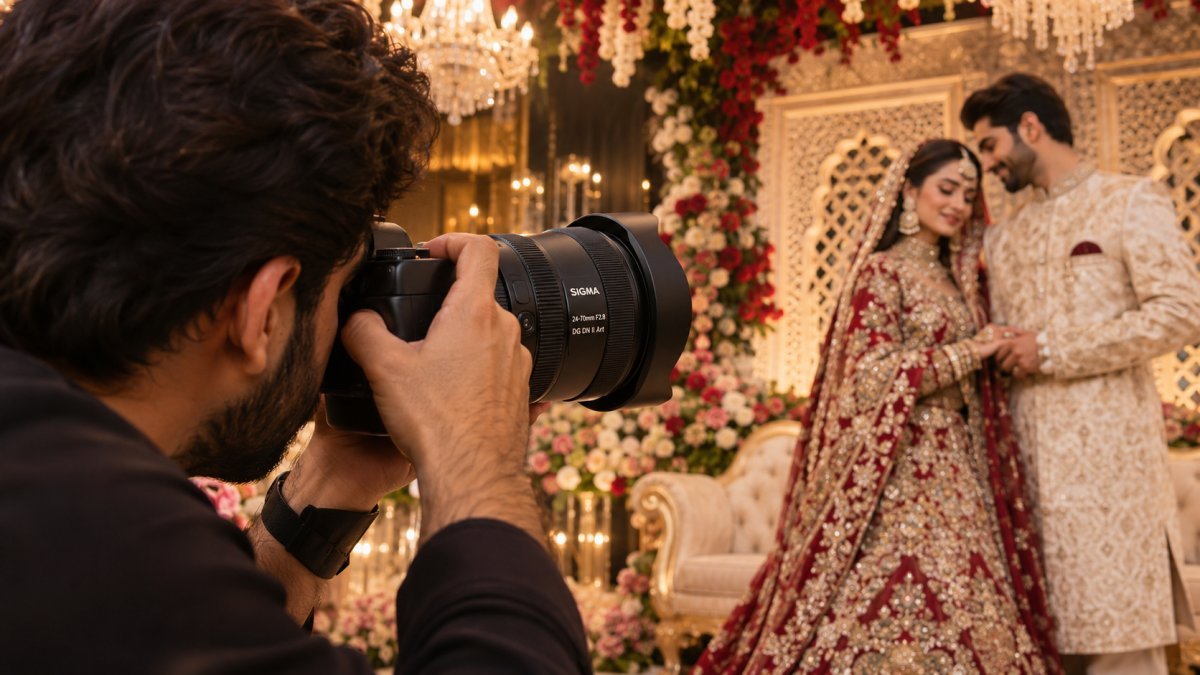


Wedding photography in Pakistan is not one single shooting situation. A professional may begin with bridal preparation in a small room, move to an outdoor couple session, cover a crowded nikah or barat entrance, photograph family groups on a decorated stage, and finish in a dim reception hall. That range makes lens choice a workflow decision, not simply a question of which lens is “sharpest.”
For photographers building a dependable professional kit, Sigma offers prime and zoom options for environmental frames, portraits, candid moments, low-light scenes, and distant stage coverage. The right combination depends on camera system, venue size, working distance, lighting, and how quickly framing needs to change.
What Professional Wedding Photographers Need From a Lens
Important factors include:
-
Useful focal length for the working distance
-
Wide enough aperture for indoor and evening events
-
Reliable autofocus for moving subjects
-
Practical size and weight
-
Fast, predictable handling
-
Correct camera mount and sensor coverage
-
Optical performance that stays dependable
Professionals usually build complementary lenses instead of expecting one lens to do everything.
Start With the Wedding Workflow
Before choosing glass, map the situations you photograph most often.
Pakistani weddings can include mehndi, nikah, barat, walima, bridal preparation, couple portraits, stage photography, group photographs, décor, candid coverage, and outdoor sessions. Each part creates a different distance between photographer and subject.
A photographer working in compact homes and bridal rooms needs more width than someone shooting from the back of a large marquee. A portrait-focused photographer may value a fast prime more than a documentary shooter who needs instant framing changes.
The better question is: Which moments must I cover without slowing down?
24-70mm F2.8: The Core Wedding Zoom
For many professionals, the 24-70mm F2.8 range is the most logical foundation of a wedding kit. It moves from wide environmental coverage to short-telephoto framing without a lens change.
The SIGMA 24-70mm F2.8 DG DN II | Art sits in this focal range and is a strong option for professionals who need versatility across changing wedding situations.
At the wider end, it can handle:
-
Venue and stage establishing shots
-
Family groups
-
Bridal preparation in tighter rooms
-
Décor and environmental storytelling
-
Fast-moving entrances
At the longer end, it works well for candid expressions, three-quarter portraits, couple frames, and ceremony details.
Its constant F2.8 aperture also keeps exposure behavior predictable while zooming. It is not automatically the best lens for everyone, but it is a strong choice when speed and versatility matter more than extreme background separation.

70-200mm F2.8: For Stage Coverage and Distance
Large halls create the opposite problem: sometimes the photographer cannot move closer.
A 70-200mm F2.8 is useful for tighter framing from a respectful distance. It complements a standard zoom by adding reach for ceremony, stage, and candid photography.
The SIGMA 70-200mm F2.8 DG DN OS | Sports can be valuable for:
-
Stage coverage from the audience area
-
Emotional candids from a distance
-
Nikah or ceremony moments where movement is restricted
-
Couple portraits with compressed backgrounds
-
Speakers and reception moments
The longer focal length can simplify busy backgrounds, but professionals should also consider weight and space. In a small bridal room, this range can be restrictive. It generally works best as a second lens rather than the only wedding lens.
35mm F1.4: Storytelling and Low-Light Coverage
A 35mm prime gives a different visual approach. Instead of removing the environment, it can show the people and the setting together.
SIGMA 35mm F1.4 Art lenses can work particularly well when photographers want environmental context along with strong low-light flexibility.
A wide F1.4 aperture can help in available light, while the focal length suits:
-
Mehndi and dance-floor candids
-
Bridal preparation
-
Family interactions
-
Environmental portraits
-
Venue storytelling
-
Low-light reception coverage
The limitation is flexibility. In crowded wedding venues, moving backward may not be possible. Photographers who rely heavily on primes should understand their shooting space before using a 35mm as the main lens.
85mm F1.4: Bridal and Couple Portraits
The SIGMA 85mm F1.4 DG DN | Art is a specialist option for tighter portrait framing and strong subject-background separation.
The focal length provides comfortable working distance for portraits, while F1.4 adds low-light and depth-of-field flexibility.
It can suit:
-
Bridal portraits
-
Groom portraits
-
Fashion-inspired wedding images
-
Emotional close-ups
-
Outdoor portraits with distracting backgrounds
An 85mm is less practical in tight rooms or for large family groups. It is strongest when paired with a wider lens rather than used throughout the full event.
Prime vs Zoom: Which Makes More Sense?
Wedding professionals do not need to choose one category permanently.
Zoom lenses are strongest when the photographer must react quickly. A 24-70mm or 70-200mm lets framing change immediately as entrances, groups, and candid moments unfold.
Prime lenses are strongest when the photographer wants a particular look, wider aperture, or specific working distance. A 35mm supports environmental storytelling, while an 85mm is better suited to controlled portraits.
|
Wedding Role |
Lens to Consider |
Main Advantage |
|
General all-day coverage |
24-70mm F2.8 |
Fast framing changes |
|
Ceremony and stage distance |
70-200mm F2.8 |
Telephoto reach |
|
Documentary and low light |
35mm F1.4 |
Environmental storytelling |
|
Bridal and couple portraits |
85mm F1.4 |
Portrait separation |
Low-Light Weddings: Aperture Is Only Part of the Answer
Pakistani wedding halls can combine dim ambient light, bright LED stages, colored spotlights, and rapidly changing exposure.
A wide aperture helps, but professionals also need to consider shutter speed, ISO, autofocus in low contrast, flash or off-camera lighting, depth of field for groups, and mixed color temperatures.
For a single portrait, F1.4 may create attractive separation. For a large family group, stopping down may be necessary so multiple faces remain acceptably sharp.
The goal is not always the widest aperture. It is having enough aperture flexibility to match the scene.
Full Frame vs APS-C: Choose the Correct SIGMA Family
Sensor format changes both compatibility and field of view.
SIGMA uses DG for lenses designed to cover full-frame sensors, DC for APS-C-oriented lenses, and DN for mirrorless designs.
For full-frame photographers, options such as the 24-70mm F2.8 DG DN II Art provide professional-standard focal coverage.
For APS-C users, lenses such as the SIGMA 18-50mm F2.8 DC DN Contemporary can provide a more compact general-purpose setup, while a compatible 56mm F1.4 DC DN Contemporary can suit portrait-focused work.
Do not buy by focal length alone. Confirm the exact camera model, sensor format, mount, and lens version first.
One Camera or Two? Lens Choice Changes
A photographer using one camera body usually benefits from a versatile zoom because lens changes during key moments create delay.
With two bodies, a professional might keep:
-
24-70mm on one body and 70-200mm on the other
-
35mm on one body and 85mm on the other
The first combination prioritizes coverage and speed.
The second prioritizes prime-lens style and low-light flexibility.
Two bodies also provide redundancy during paid assignments, which can be particularly important during once-only moments such as the nikah, ring exchange, entrances, or key family photographs.
Do You Need a Macro Lens for Details?
A macro lens is useful but not essential for every wedding photographer.
Rings, jewelry, invitations, embroidery, perfume bottles, shoes, and décor can benefit from close focusing. A dedicated macro option such as the SIGMA 105mm F2.8 DG DN Macro | Art can add another creative dimension to premium wedding coverage.
However, add a macro only if detail photography is a meaningful part of your deliverables. Improving the core zoom-and-prime kit usually gives more value first.

What Should a Professional Buy First?
Priority should follow the limitation that affects paid work most often.
Need one dependable lens?
Start with a constant-aperture standard zoom such as a 24-70mm F2.8.
Portraits are your weakness?
Add an 85mm-class fast prime.
Ceremonies and stages are difficult to reach?
Add a 70-200mm F2.8.
Your style is documentary and available-light focused?
Consider a fast 35mm prime.
The objective is not to own every lens. It is to remove the problems that repeatedly slow down professional coverage.
Check Mount Compatibility Before Buying
SIGMA produces lenses for multiple systems, but every model is not available for every mount.
Before purchasing, verify:
-
Exact camera model
-
Sensor format
-
Exact SIGMA lens model
-
Correct mount version
-
Autofocus and electronic compatibility
A lens can be excellent for weddings and still be the wrong purchase if it does not match the photographer’s camera system.
Final Thoughts
Professional wedding photography in Pakistan requires flexibility because no two parts of the event behave the same way.
A 24-70mm F2.8 is a strong foundation for general coverage. A 70-200mm F2.8 adds reach for ceremonies and large stages. A 35mm F1.4 supports documentary storytelling and available-light work, while an 85mm F1.4 gives bridal and couple portraits a more specialized look.
The right kit is not the one with the most lenses. It is the one that lets the photographer move through bridal preparation, groups, ceremonies, portraits, candids, and receptions without fighting the equipment.
Choose according to venue size, lighting, working distance, camera compatibility, and the moments clients expect you to deliver. That is a stronger professional strategy than buying a lens simply because it is popular.
FAQs
Which SIGMA lens is most practical for wedding photography in Pakistan?
For photographers who need one versatile lens, a 24-70mm F2.8-class zoom is a practical starting point because it covers wide venue shots, groups, candids, and short-telephoto framing.
Is a 35mm or 85mm better for weddings?
They serve different roles. A 35mm is better for environmental storytelling, tight spaces, and documentary coverage, while an 85mm is better suited to tighter bridal and couple portraits.
Do professional wedding photographers need a 70-200mm lens?
Not every photographer needs one, but it is useful for large venues, ceremony coverage, stage photography, and candid images when the photographer cannot move close to the subject.
Is F1.4 necessary for wedding photography?
No. F1.4 can help in low light and create shallow depth of field, but F2.8 zooms remain highly practical because they combine useful brightness with flexible focal lengths.
How many lenses should a professional wedding photographer carry?
There is no fixed number. A carefully chosen two- or three-lens kit can cover most assignments if the focal lengths complement each other. Professionals should prioritize backup coverage and real workflow needs rather than carrying unnecessary equipment.
What's Your Reaction?
 Like
0
 Dislike
0
 Love
0
 Funny
0
 Wow
0
 Sad
0
 Angry
0

SIGMA Pakistan is your trusted destination for professional SIGMA cameras, camera lenses, cine lenses, and photography equipment. Explore innovative products designed and engineered in Japan, including Art, Sports, and Contemporary lenses, along with the SIGMA BF camera. Discover premium gear, expert support, warranty services, and solutions for photographers and filmmakers across Pakistan.








Comments (0)